Knowing was never
the problem.
We know how we want to act. Under pressure, the autopilot takes over anyway. mondayLAB works on the space in between — in your everyday work, before, during and after the meeting.
For teams and leaders where reactive mode takes over under pressure — with consequences that have to be corrected, renegotiated or contained as escalation after the fact.
Three scenes.
Someone says something. The answer comes at once.
Only afterwards does it become clear what was said.
Agreement, though inwardly there is a no.
The pressure was more uncomfortable than the objection.
You know how it would have been better.
But in the moment itself — there was no room.
Barely visible in the individual. In a team, it becomes a pattern.
Without it, the rest
comes to nothing.
We can learn as much as we like about leadership, communication or resilience. What matters is whether we can draw on it in the right moment.
It's not the will that's missing. It's the moment. Between knowing and doing lies a second. It doesn't disappear – the greater the pressure, the more often it returns. It is rarely ability that's lacking. The real question is whether we can still steer ourselves even when the load grows and decisions count.
Self-regulation is exactly this ability: to act deliberately under pressure, make better decisions and communicate clearly. It is the foundation on which resilience, leadership and communication first become effective.
Experience it first.
This is how an observation task works in everyday life. Tap the phone and try it yourself.
Notice
Module 1 · Level 01
An example task, about 30 seconds.
One foundation,
two paths.
It measures, across four phases, how you regulate under pressure. The result is your SELF Report as a current-state snapshot — a moment in time that you can also use on your own.
From the individual results, an anonymized team profile emerges — a shared working hypothesis of what the team pays attention to over twelve weeks. Not a judgment about the team.
Individual Baselines
Each person begins with their own Baseline.
Anonymized team profile
The results are brought together anonymously. It opens a shared question: What should we pay attention to over the next twelve weeks?
12 weeks of observation & reflection
The answer becomes the shared working hypothesis for twelve weeks.
Schematic representation, not real values. Individual people are surveyed; the anonymized team profile serves as a shared working hypothesis.
Deepen self-leadership over weeks, with weekly observation tasks, personal reflection and 1:1 support.
Individual Baseline
Each person starts with their own SELF Report as a current-state snapshot.
5 months of support
Weekly observation tasks, one 1:1 session per module and live elements. Less than an hour a week.
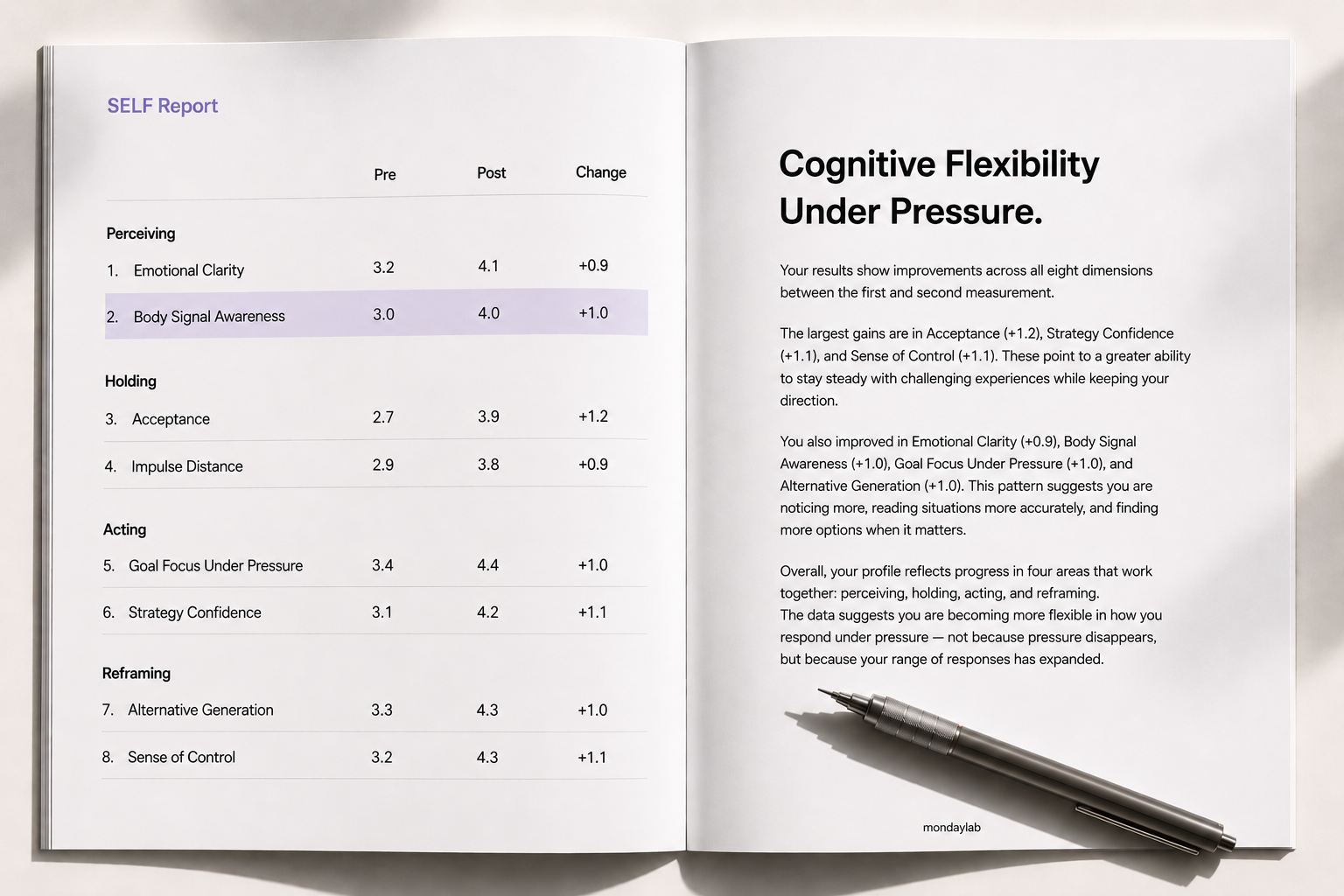
SELF Report over time
The snapshot becomes a trajectory: where it began and what has shifted.

„I know the 17:48 moment from the inside — and, as a psychologist, from the outside. Between knowing and doing lies a second. What counts is noticing it in the moment itself and steering it differently. Everything else builds on that."
Psychologist M.Sc. · B.Sc. Business Psychology · Systemic Coach, DBVC- & ICF-certified · Lecturer in Social Psychology · self-employed since 2022
mondayLAB didn't come from a desk. It comes from working with people who brought everything: knowledge, experience, will. And still, under pressure, reactive mode took over — not from any lack, but because self-regulation is taught nowhere. That is exactly what mondayLAB is for.
The sum of the journey.
We make visible what often stays hidden in everyday life: the patterns, progress and changes that have developed over weeks and months of the journey.
„Had I known how much the format would help me, I would have done it during my peak phase in February, the phase when I had no time for anything."SELFLEAD participant
What could this look like for you?What participants report.
In high-pressure situations I now make far more deliberate decisions, and I deal with both myself and the people around me more clearly and with more composure. I understand my personal trigger points much better today and can reflect on them deliberately. Especially in my job, which comes with a lot of responsibility and high pressure, this helps me act more calmly and make better decisions.
What has changed most for me is that I notice, in the situation itself, what is happening and respond deliberately, right away. Recently at a trade fair, some staff were behaving improperly: I addressed it and stopped it immediately, instead of letting it run and stepping in too late. In the past, I would have hesitated or reacted on impulse in a moment like that. Now I can read what is unfolding more quickly and respond to it cleanly.
I've learned that I don't always have to (re)act right away. I now give myself more time between an external trigger and my response, and use that space actively to steer how I act. I used to react impulsively, straight from the gut. Today I feel calmer, because I allow myself this deliberate pause between stimulus and response.
Translated from the original German.
What you want to know.
Experience self-regulation.
An interactive talk about the moment under pressure, where it's decided whether we react or act.
Instead of talking about self-regulation, we make it personally tangible — through a concrete situation from your own everyday working life.
Clearer decisions under pressure · More composed in negotiations · Out of reactive mode · Deciding more deliberately
Request a talkLet's talk.
The Baseline is the first step and provides a concrete foundation for how to proceed.
For teams — or talents, experts and leaders.
Request the Baseline